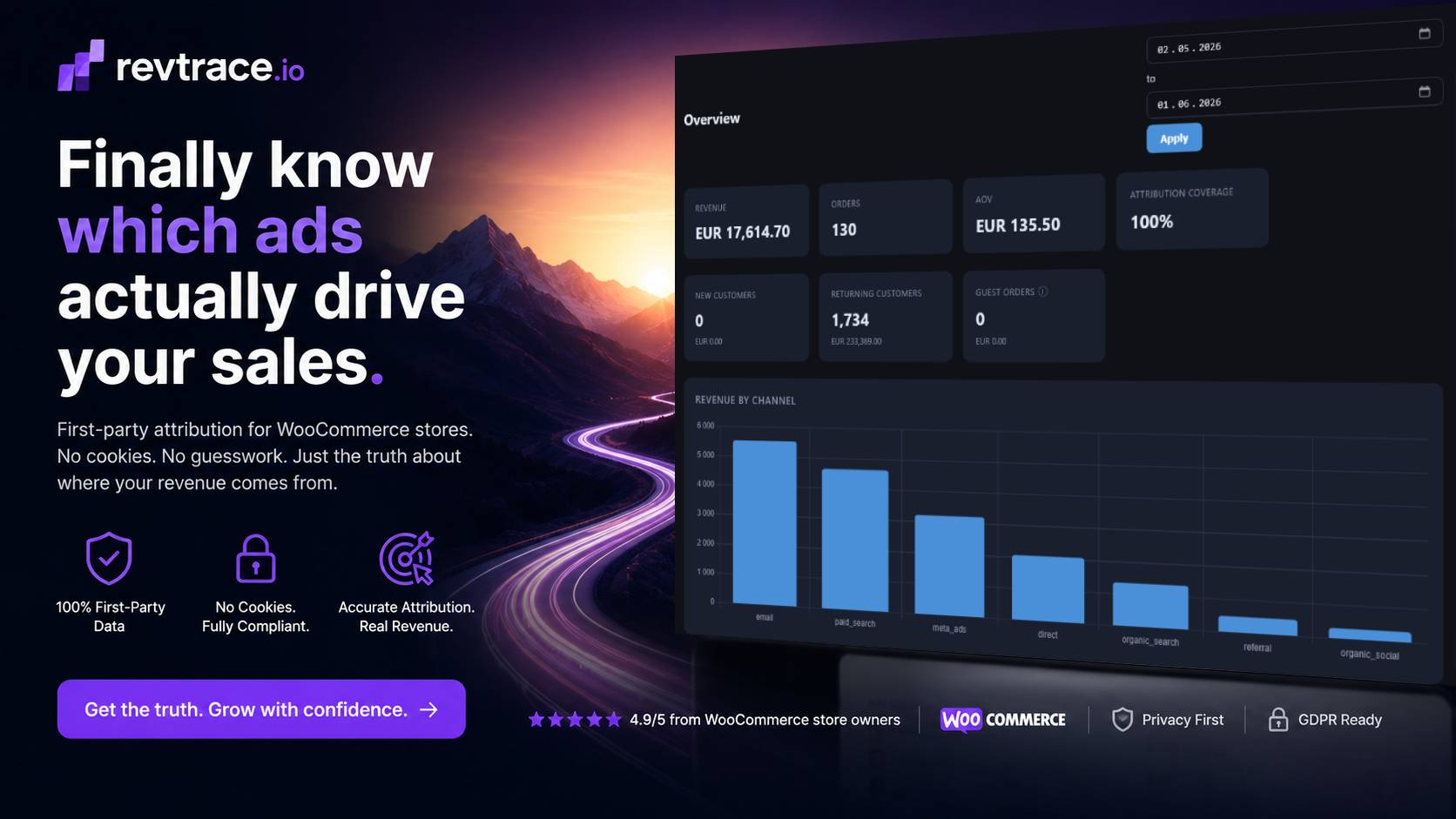
Most Woocommerce stores can’t answer this million-dollar question accurately. Here’s why that’s costing you more than you think — and what to do about it.
Black Friday is over. The adrenaline has faded. You’re staring at a revenue number that looks pretty good, and your marketing team is already arguing over who deserves credit for it.
Your Facebook Ads dashboard says Facebook drove $31,000 in sales. Your Google Ads account claims $28,500. Your email platform is showing $19,200 in attributed revenue. Add it all up and you’re looking at $78,700 in claimed conversions — against actual revenue of $50,000.
The math doesn’t work. It never does.
This is the attribution crisis quietly draining Woocommerce stores every single year, and most store owners don’t even know they’re living inside it.
The Illusion of Marketing Data
Here’s a truth the ad platforms don’t put in their case studies: every platform measures success in a way that makes itself look as good as possible.
That’s not a conspiracy. It’s just incentive design.
Meta counts a conversion if someone saw your ad and bought anything within 7 days — even if they found you through a Google search 6 days later. Google counts a click-through conversion if someone clicked your Shopping ad, went away, then came back via a direct bookmark. Your email platform counts a conversion if someone opened a newsletter, ignored it, and bought three weeks later through an influencer link.
Every platform is technically correct by its own rules. But every platform is also wildly overstating its contribution to your bottom line.
When you’re spending $50,000 on Black Friday marketing across four or five channels, this isn’t a rounding error. This is the difference between scaling the right channel 3x next year — and pouring more money into the one that only looked like a winner.
Why WooCommerce Stores Are Especially Exposed
Shopify merchants have their own attribution headaches, but WooCommerce stores face a uniquely messy landscape.
WooCommerce gives you enormous flexibility, which means most stores are stitching together a patchwork of plugins, tracking scripts, and integrations — each with its own logic for what counts as a conversion, what counts as a session, and how UTM parameters are handled.
Add to this the growing privacy landscape — Safari’s Intelligent Tracking Prevention, iOS 14+ changes, ad blockers running on 30–40% of desktop browsers — and the picture gets even murkier. Third-party cookies, which most attribution tools rely on, are being blocked, expired, or deprecated out of existence.
The result? By some estimates, WooCommerce stores operating on traditional attribution models are misreading 30–50% of their conversion data.
That’s not a small leak. That’s a hole in the hull.
The Four Attribution Lies You Believed Last Black Friday
Lie #1: “Our Facebook ROAS was 4.2x”
Facebook’s reporting lives inside Facebook’s walled garden. It counts view-through conversions (someone saw an ad but never clicked it), applies a 7-day click window by default, and matches conversions using probabilistic modeling when pixel data is limited. The 4.2x figure is a platform-generated estimate, not a ground-truth measurement.
Lie #2: “Email was our best channel — look at the revenue it drove”
Email platforms attribute revenue to any purchase made within a window after an open or click. But your customer who opened a Black Friday email, searched Google for your brand name, clicked a paid search ad, and then bought — that sale was just triple-counted. Email claimed it. Google claimed it. Maybe even direct traffic claimed it.
Lie #3: “We can track everything with GA4”
Google Analytics 4 is a powerful tool, but it’s not immune to data loss. Session timeouts, cross-device journeys, UTM parameters that get stripped by redirect chains, and first-party cookie limitations all create gaps. GA4 gives you a view of the customer journey — but it’s a view with significant blind spots, particularly on mobile and across multi-day, multi-device paths.
Lie #4: “Our best customers came from organic social”
Organic social is notoriously difficult to attribute. Dark social — sharing through messaging apps, screenshots, private communities — is effectively invisible to standard tracking. When someone shares your Black Friday deal in a WhatsApp group and five people buy, that traffic often shows up as direct or gets absorbed into the last-click channel that happened to close the sale.
What Accurate Attribution Actually Looks Like
The goal of true attribution isn’t to punish your best-performing channel or reward your worst one. It’s to understand the **actual commercial contribution** of each touchpoint in a customer’s journey — so you can allocate next year’s budget with confidence instead of guesswork.
That means measuring:
Revenue, not clicks. Clicks, impressions, and even sessions are proxy metrics. What matters is actual revenue generated — matched to real orders in your WooCommerce database, not estimated by a platform’s algorithm.
Channel contribution, not channel credit. A customer might have been introduced to your brand through a YouTube pre-roll, nurtured through a retargeting sequence, converted after an email push, and closed via a branded search. Each touchpoint contributed. Assigning 100% of the credit to the last click — or even the first — misrepresents the whole story.
First-party data, not platform self-reporting. The moment you measure performance using data collected by the platforms themselves, you’re asking them to grade their own homework. First-party measurement — connecting marketing activity to actual purchase data at the order level — is the only way to cut through the noise.
Cross-device journeys. The average B2C customer uses 3.5 devices before completing a purchase. If your attribution model can’t stitch together a mobile-first research session with a desktop checkout, you’re systematically under-crediting mobile touchpoints and over-crediting desktop ones.
The Real Cost of Getting This Wrong
Bad attribution data doesn’t just give you the wrong answer about last quarter. It compounds.
When you double down on a channel that appeared to perform well — because it aggressively claims conversions — you shift budget away from channels that were actually driving incremental revenue but measuring it conservatively. Next Black Friday, your inflated spend on the wrong channel delivers disappointing results. You assume it was execution. You try harder. The cycle repeats.
Meanwhile, the channel that was quietly doing the heavy lifting — the one that doesn’t claim every conversion in a 7-day window — keeps getting underfunded. Its influence on your most valuable customer segments goes unrecognized. You might even cut it.
Over three to five years, the cumulative effect of bad attribution on budget allocation decisions can be worth more than the original $50,000 question. For stores doing seven figures per year, we’re talking about potentially hundreds of thousands of dollars in misallocated spend.
What to Do Before Next Black Friday
You don’t have to wait until November to fix this. The best time to build a reliable attribution system is right now, during the quiet months — before the traffic volume makes it harder to isolate variables and test assumptions.
Start by auditing your current attribution setup. Pull the claimed revenue from every platform you ran campaigns on during the last major sale event. Add them up. Compare to actual WooCommerce revenue. The gap between those two numbers is your current “attribution inflation rate” — and it’s a sobering benchmark.
Move toward server-side tracking. Client-side tracking (JavaScript pixels firing in the browser) is increasingly unreliable. Server-side tracking, where conversion events are sent directly from your server to analytics platforms, bypasses ad blockers, isn’t affected by ITP, and doesn’t depend on third-party cookies. It’s more accurate, more durable, and more future-proof.
Demand revenue-level data, not session-level data. Most analytics tools tell you how many sessions came from each channel. That’s interesting, but it’s not the whole story. You want to see how much *revenue* each channel generated — and for that, you need a system that connects marketing touchpoints to actual WooCommerce order IDs.
Stop trusting platform-reported ROAS as your north star. Use it as a directional signal, not a decision-making metric. Treat any platform’s self-reported performance numbers with the same skepticism you’d apply to a salesperson’s pitch for their own product.
The Future of Attribution Is First-Party
The cookie-less future everyone’s been warning about for years is no longer a future concern — it’s a present reality for a significant portion of your traffic. Safari has been blocking third-party cookies since 2017. Firefox joined in. Chrome’s deprecation timeline has been delayed, but the direction is clear.
Stores that built their measurement infrastructure around third-party cookies and platform self-reporting are already operating with degraded data. The gap between what they think they know and what’s actually happening in their customer journeys is widening every year.
The stores that will win the attribution game in the next five years are the ones building first-party data infrastructure today. That means collecting behavioral and conversion data directly, on your own servers, under your own control — and using that data to measure marketing performance against ground truth (your actual orders), not against platform-generated estimates.
This isn’t about being contrarian toward Facebook or Google. Both platforms can still be powerful growth levers. It’s about measuring their contribution honestly — so you can invest in them wisely.
The $50K Question, Answered
So: which channel actually drove your Black Friday sales?
If your answer comes entirely from platform dashboards, the honest answer is: you don’t know yet.
But here’s the thing — you can know. The data exists. Every order in your WooCommerce database has a story: a first touchpoint, a nurture sequence, a final click. The infrastructure exists to connect those dots in a way that doesn’t rely on any platform to grade its own homework.
What’s missing for most stores isn’t the data. It’s the system that connects it.
That’s the gap Revtrace was built to close.
Revtrace gives WooCommerce stores exact revenue attribution by channel — based on your actual order data, not platform self-reporting, and without any reliance on third-party cookies. If you’ve ever looked at your marketing dashboards after a big sale and felt like the numbers didn’t quite add up, you already understand the problem we solve.