Cookie deprecation is coming — here’s what WooCommerce stores need to know.
There’s a moment every WooCommerce store owner dreads.
You log into your ad platform, look at the reported ROAS, and it tells you your campaigns are performing brilliantly. Then you open your actual revenue dashboard, and the numbers don’t match. Not even close.
You’re not doing anything wrong. You’re not missing a setting. The problem is structural — and it’s about to get worse.
The marketing data ecosystem that most online stores have been built on for two decades is quietly collapsing. Third-party cookies — the invisible trackers that have powered everything from Facebook retargeting to Google attribution — are being phased out. Browsers are blocking them. Regulators are restricting them. Users are rejecting them.
If your WooCommerce store’s marketing decisions still rely on third-party cookies, you’re flying a plane that’s slowly running out of fuel.
This guide is your parachute.
The Problem: You’ve Been Handed Someone Else’s Map
Here’s a story you might recognise.
You spend €3,000 on a Google Shopping campaign. Google reports €9,000 in conversions — a 3x ROAS. Impressive. You scale the budget. But your actual store revenue barely moves. Where did those conversions go? Who bought what, and from where?
The uncomfortable truth: you were never seeing a complete map. You were seeing Google’s version of your customers’ journey. And Google’s map was drawn with third-party cookies — a technology that was never designed for attribution accuracy. It was designed for advertising.
Third-party cookies are small data files dropped by external companies (advertisers, data brokers, analytics platforms) onto your visitors’ browsers without those visitors having a direct relationship with those companies. For years, these cookies let platforms like Meta and Google follow users across the internet, build behavioural profiles, and report back on conversions.
The catch? Every platform uses its own cookies. Every platform claims credit. Every platform shows you its own version of reality.
You never owned the data. You rented someone else’s interpretation of it.
What Third-Party Cookie Deprecation Actually Means
Let’s be precise about what’s happening, because a lot of noise is being generated around this topic.
Google Chrome — which holds roughly 65% of global browser market share — has been on a multi-year journey to phase out third-party cookies entirely. Safari (Apple) and Firefox (Mozilla) already block them by default. The direction of travel is unambiguous: the third-party cookie era is ending.
For WooCommerce store owners, this means:
- Retargeting audiences will shrink. Platforms can no longer reliably track which users visited your product pages or abandoned carts across sessions.
- Conversion reporting will degrade further. The already-inflated attribution numbers platforms self-report will become even less reliable.
- Lookalike audiences will weaken. The behavioural data that powers these tools is largely derived from third-party tracking.
- Cross-device tracking will break. Following a customer from their mobile ad click to their desktop purchase? That journey becomes invisible.
Here’s the crucial thing most guides don’t tell you: for many WooCommerce stores, the data is already broken. iOS 14.5 (Apple’s App Tracking Transparency update, released in 2021) already gutted Meta’s tracking capabilities. The full deprecation of Chrome’s third-party cookies is the final chapter of a story that’s been unfolding for years.
If you’ve noticed your Meta attribution getting murkier and your Google ROAS numbers feeling disconnected from reality — this is why.
First-Party Data: The Only Map You Actually Own
Here’s where the story changes.
First-party data is information you collect directly from your own customers and visitors — with their knowledge and, where required, their consent. It lives on your servers. It belongs to you. No platform can take it away, deprecate it, or restrict your access to it.
For a WooCommerce store, first-party data includes:
- Purchase data — what your customers bought, when, how much they spent, how often they return
- Email addresses — the most durable identifier in digital marketing
- On-site behaviour — which pages visitors browse, what they add to cart, where they drop off
- Customer lifetime value — the actual, real revenue a customer has generated over their relationship with your store
- UTM parameters — the source, medium, and campaign data attached to every link your customers click
Notice what’s absent from that list: anyone else’s interpretation of your data. No platform self-reporting. No algorithmic attribution models you can’t audit. No shared identifiers that third parties control.
First-party data is your store’s ground truth.
Why Most WooCommerce Stores Are Still Losing This Battle
Understanding first-party data intellectually is easy. Actually capturing it and using it to make decisions is where most store owners stumble.
Here’s the typical WooCommerce setup:
- Google Analytics 4 tracks sessions — sort of — but struggle with cross-device journeys and doesn’t clearly show you which campaigns drove which revenue.
- Meta Pixel reports conversions — but since iOS 14, it’s using modelled data that often overcounts.
- Google Ads has its own conversion tracking — which also overcounts.
- You’re running email marketing through Klaviyo or Mailchimp — which also reports attributed revenue.
Add all those numbers together and your “total attributed revenue” is often 3–5x your actual revenue. Every platform is claiming credit for the same sales.
This isn’t a marketing problem. This is a data infrastructure problem.
The issue isn’t that first-party data doesn’t exist. Your WooCommerce store is generating it constantly — every order, every session, every email open. The issue is that without a proper system to consolidate and attribute that data, you end up relying on the platforms’ self-reported numbers because they’re the only numbers you have that look complete.
And when platforms report their own performance metrics, they have an obvious incentive to make those numbers look good.
The Four Marketing Questions Every WooCommerce Store Must Answer
Before we get into the solution, let’s get clear on what you actually need to know to run a profitable store.
Question 1: Which channel brought this customer to my store?
Not which channel claims credit — which channel actually drove the first touchpoint that started the relationship.
Question 2: Which channel was present at the moment of purchase?
The last click before a conversion matters. So does understanding whether that click came from a paid ad, an organic search, a social post, or an email.
Question 3: What is each channel’s true contribution to revenue — this month, measured in actual euros or dollars?
Not ROAS as reported by the platform. Actual revenue in your WooCommerce order management system, traced back to its source.
Question 4: Which channels are acquiring customers who come back and buy again?
Acquisition cost is only half the picture. A channel that brings in one-time buyers who never return is fundamentally different from a channel that brings in loyal customers — even if their initial order values are identical.
Third-party cookies were supposed to answer these questions. They never did it accurately, and now they’re going away.
First-party data — properly captured and structured — can answer all four.
How First-Party Attribution Actually Works
Let’s make this concrete.
When a potential customer clicks on one of your ads or organic links, they arrive at your WooCommerce store with a URL that looks something like this:
yourstore.com/product/blue-running-shoes?utm_source=google&utm_medium=cpc&utm_campaign=running-shoes-spring
Those UTM parameters — utm_source, utm_medium, utm_campaign — are first-party data. They’re in the URL. They’re yours. No cookie required to read them.
A robust first-party attribution system does the following:
- Captures those UTM parameters the moment someone lands on your site and stores them server-side, tied to a session identifier.
- Persists that attribution data so if the visitor leaves and returns later (via a direct visit or email click), you still know where they originally came from.
- Passes that attribution data to your WooCommerce order when a purchase is made, so every order in your database carries its source information.
- Aggregates that order-level data to show you, channel by channel, exactly how much real revenue each source generated — in the same currency that appears in your bank account.
The key difference from platform-reported attribution: the source of truth is your WooCommerce order database, not the advertising platform’s algorithm. Revenue figures match your actual sales. No inflation. No double-counting.
The Practical Transition: What to Do Right Now
If you’re a WooCommerce store owner who has been relying on platform-reported data, here’s your action plan — in order of priority.
Step 1: Audit Your Current Attribution Setup
Open your WooCommerce orders from last month. Now open Google Ads. Now open Meta Ads. Now open your email platform.
Add up all the attributed revenue from each platform. Compare it to your actual WooCommerce revenue.
If the platforms’ total is more than 30% higher than your actual revenue, you have a significant attribution problem. Most stores find it’s 200–400% higher. That gap represents wasted budget — money spent scaling channels based on inflated numbers.
This exercise is sobering. It’s also necessary. You can’t fix a problem you haven’t measured.
Step 2: Implement UTM Discipline Across Every Campaign
Every link from every paid campaign, every email, every social post should carry UTM parameters. This is non-negotiable.
Establish a consistent naming convention:
utm_source= the platform (google, meta, klaviyo, etc.)utm_medium= the channel type (cpc, email, organic, social)utm_campaign= the specific campaign name
If you’re inconsistent with UTM naming, your first-party data becomes noise. Consistency is the foundation everything else is built on.
Step 3: Store Attribution at the Order Level
This is where most WooCommerce stores fall short. UTM parameters are captured by Google Analytics — but Google Analytics doesn’t connect to your actual order revenue in a way you can fully control and audit.
You need a system that writes the UTM source data directly to your WooCommerce order record at the moment of purchase. This can be done through custom WooCommerce order metadata, or through a dedicated attribution tool built for WooCommerce.
When attribution lives in your order database, you own it permanently. Platform changes, cookie deprecations, algorithm updates — none of that can touch it.
Step 4: Build a Revenue-by-Channel Report You Trust
Once attribution is being captured at the order level, you need a way to aggregate it. What you’re building toward is a single view that shows:
| Channel | Orders Last Month | Revenue Last Month | Avg. Order Value | New vs. Returning |
|---|---|---|---|---|
| Google / CPC | 142 | €18,340 | €129 | 78% new |
| Meta / CPC | 87 | €9,650 | €111 | 65% new |
| Email / Klaviyo | 203 | €24,100 | €119 | 12% new |
| Organic / SEO | 94 | €11,280 | €120 | 91% new |
| Direct | 67 | €8,940 | €133 | 41% new |
This table — built from your WooCommerce order data — is more valuable than any dashboard any ad platform will ever show you. Because it’s real. It’s your money. It came from your store.
Step 5: Use Server-Side Tracking to Feed Platforms Better Data
Here’s an important nuance: the goal isn’t to abandon advertising platforms. The goal is to stop trusting their self-reported attribution while continuing to use their targeting capabilities.
Server-side tracking (through tools like Meta’s Conversions API or Google’s Enhanced Conversions) allows you to send conversion events directly from your server to the platform — bypassing browser-based cookie limitations entirely.
This improves the platform’s ability to optimise campaigns without giving up control of your attribution truth. Think of it as feeding the algorithm good data while keeping the real revenue scorecard on your side.
What Good First-Party Data Makes Possible
Let’s talk about the upside, because this isn’t just a defensive exercise.
You stop wasting budget on channels that look good but perform poorly. When you can see that Meta is reporting €12,000 in conversions but your order data shows only €4,200 came from Meta-sourced sessions, you stop scaling Meta based on the inflated number. That’s real money redirected to channels that are actually working.
You can calculate true Customer Acquisition Cost. Real revenue divided by real ad spend. No platform inflation. No modelled data. Just the number that tells you whether your business is economically healthy.
You can identify your best customers’ origins. Which channel brings in customers with the highest lifetime value? With first-party order data, you can answer this definitively. Maybe Google shoppers buy once and disappear. Maybe email subscribers buy three times a year for three years. That insight changes how you allocate budget entirely.
You become immune to platform changes. iOS 15, iOS 17, Chrome’s deprecation, Meta’s attribution window changes — every time a platform shifts the rules, stores built on third-party data scramble to adapt. Stores built on first-party data just keep running on their own truth.
You can personalise at scale. Purchase history, browsing behaviour, email engagement — all first-party, all yours. The personalisation capabilities this unlocks (in email sequences, on-site recommendations, retargeting lists built from your own data) are more powerful and more durable than anything built on third-party tracking.
The Mindset Shift: From Renting to Owning
Donald Miller, in Building a StoryBrand, talks about the danger of making your customers confused. The same principle applies to your data.
When you rent your attribution from advertising platforms, you’re operating in someone else’s story. The platform is the hero — their algorithms, their tracking, their reporting. You’re the customer, kept in the dark, dependent on their interpretation of your business.
When you build first-party data infrastructure, you become the author of your own story. Your WooCommerce store is the source of truth. Your order data is the final word. The platforms become tools you use — not oracles you trust.
This shift is irreversible. Once you’ve seen your actual revenue numbers traced to their actual sources, you can’t go back to trusting platform-reported ROAS.
A Word About What This Isn’t
This guide is not anti-advertising. Paid channels can be extraordinarily effective for WooCommerce stores. Google Shopping, Meta prospecting, Pinterest — these are legitimate, high-ROI channels when managed properly.
The argument here is not to stop using them. The argument is to stop letting them grade their own homework.
Run the ads. Use the platforms’ optimisation capabilities. But measure their actual contribution to your revenue independently — with your own data, your own attribution, your own numbers.
That independence is what separates stores that scale sustainably from stores that wake up one day and realise they’ve been pouring budget into a funnel that wasn’t performing the way the dashboard said it was.
The Bottom Line
Cookie deprecation isn’t a future threat. The damage to third-party tracking accuracy has already happened. The remaining question is whether your WooCommerce store will adapt — or continue making budget decisions based on data that doesn’t reflect reality.
First-party data is not a technical luxury reserved for enterprise retailers. It’s table stakes for any WooCommerce store that wants to know the truth about its marketing.
The good news: your store is already generating first-party data every single day. Every order. Every session. Every email click. The infrastructure to capture, store, and act on that data is more accessible than it’s ever been.
The only question is whether you’re using it.
Ready to See Your Real Revenue by Channel?
Revtrace.io is built for exactly this moment.
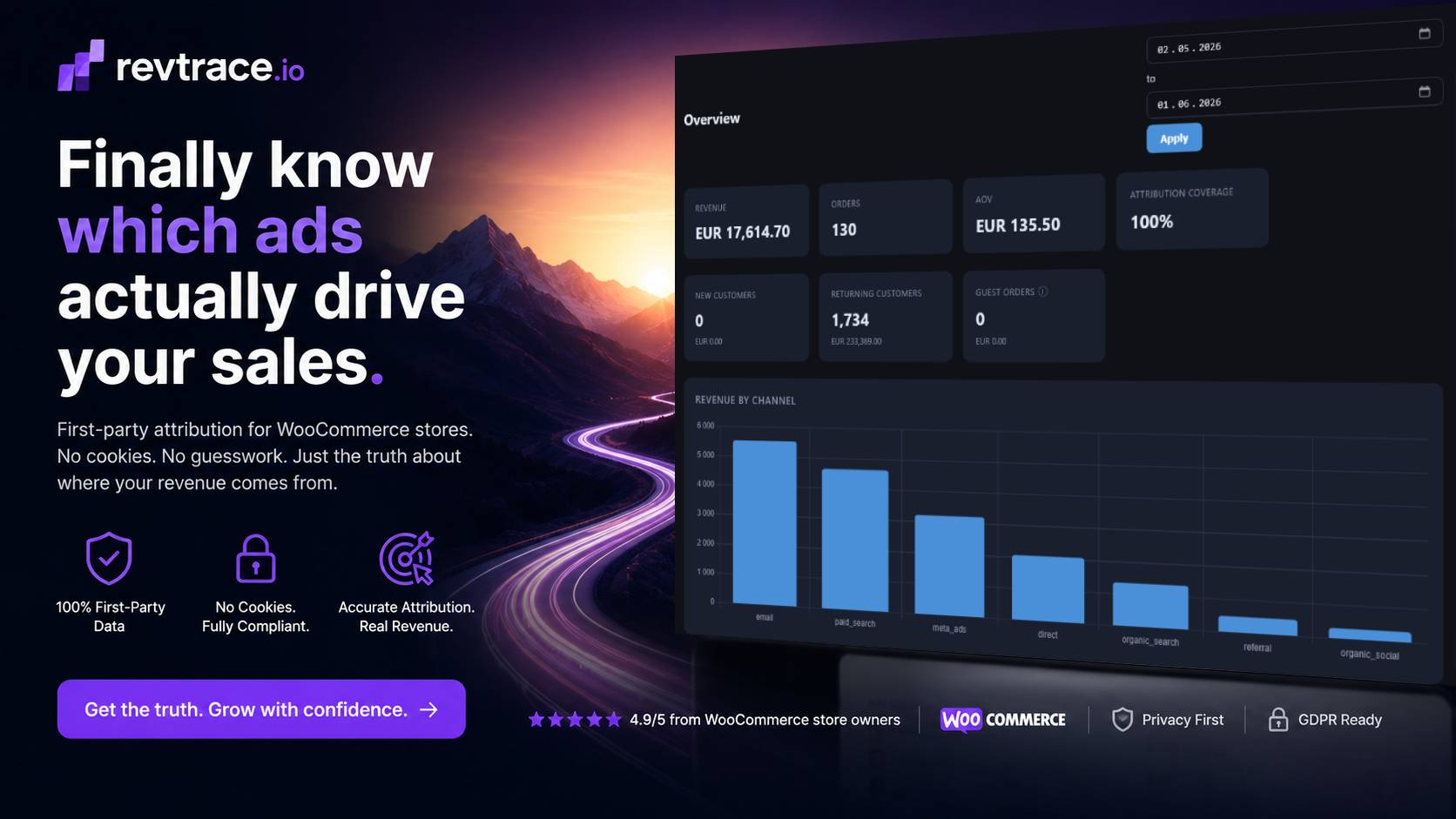
It’s a platform designed specifically for WooCommerce stores that shows you exactly how much revenue each of your marketing channels generated — tracked at the order level, with zero reliance on third-party cookies and zero dependence on platform self-reporting.
No more reconciling Google’s numbers against Meta’s numbers against your actual bank balance. Just clean, accurate, channel-by-channel revenue attribution — sourced directly from your WooCommerce store.
If you’ve ever looked at your ad platform dashboards and wondered whether any of it was real, Revtrace.io is the answer you’ve been waiting for.