Shopify stores have a massive advantage that WooCommerce owners don’t even know they’re missing.
It’s not a plugin. It’s not a theme. It’s not even a feature you can buy.
It’s the answer to one simple question that every store owner asks at the end of every month:
“Where did my sales actually come from?”
Shopify’s native analytics answers this question automatically. WooCommerce does not. And that gap — silent, invisible, and easy to ignore — is quietly draining thousands of dollars from WooCommerce stores every single month.
The Problem Nobody Talks About at WooCommerce Conferences
Let’s paint a picture you might recognize.
You’re running a WooCommerce store. You’re spending money on Google Ads, maybe some Meta campaigns, a bit of email, and some influencer shoutouts you negotiated last quarter. Business is decent. Revenue is coming in.
But here’s the question that keeps you up at night: which of those channels actually worked?
You open Google Analytics. It says organic brought in 40% of your revenue. But wait — Meta’s dashboard says Meta brought in 60%. And your email platform is confidently reporting that email drove 55% of last month’s sales.
The math doesn’t add up. It never does. And yet you’re supposed to make budget decisions based on these numbers.
This is not a small inconvenience. This is a fundamental breakdown in how you run your business.
Why This Is Happening to You (And Not to Your Shopify Competitors)
Here’s the uncomfortable truth: WooCommerce was not built with attribution in mind.
WooCommerce is an open-source plugin. It does what it does brilliantly — it lets you sell products on WordPress. But it was never designed to close the loop between a customer clicking an ad and a purchase landing in your order dashboard.
Shopify, on the other hand, is a closed ecosystem. Every transaction flows through their infrastructure. They can see the full journey — the click, the session, the cart, the purchase — and stitch it together natively.
WooCommerce stores, by default, rely on a patchwork of third-party tools to try to replicate this:
- Google Analytics — which tracks sessions, not orders, and breaks when users clear cookies or switch devices
- Meta Pixel — which uses modeled data and has been increasingly unreliable since iOS 14 privacy changes
- Platform self-reporting — meaning each ad platform grades its own homework, and shockingly, they all claim to be winning
The result? You’re making spending decisions based on data that’s contradictory, incomplete, and often just flat-out wrong.
The Real Cost of Not Knowing
Let’s be specific about what bad attribution actually costs you.
Say you’re spending $3,000/month across three channels: Google Ads, Meta Ads, and an email tool. Without reliable attribution, you do what most store owners do — you make a gut call, maybe cut the channel that feels slow, and hope for the best.
But what if the channel you cut was quietly driving 40% of your revenue? What if the channel you doubled down on was actually cannibalizing organic traffic you were already getting for free?
This happens constantly. And the math is brutal:
Misallocating $3,000/month by just 30% costs you $900 in wasted spend — every single month. That’s $10,800 a year. For a store doing $500K in annual revenue, bad attribution decisions can easily suppress growth by six figures.
And it’s not just the wasted spend. It’s the opportunity cost of the channels you didn’t scale because you couldn’t prove they were working.
The Cookie Problem Made It Worse
If you’ve been running a WooCommerce store for more than two years, you’ve noticed something: your attribution data got a lot murkier around 2021.
That’s when Apple’s iOS 14 update and the broader push toward browser privacy began systematically dismantling the third-party cookie infrastructure that most digital marketing tracking relied on.
What used to be (somewhat) reliable pixel tracking became, overnight, a guessing game. Meta started using “modeled” conversions — which means they’re estimating what they can no longer track directly. Google followed suit. Tag Manager setups that used to give you decent data started returning incomplete reports.
The industry responded by offering “solutions” — Conversions API integrations, server-side tracking, enhanced matching. Each one requires developer time, ongoing maintenance, and still relies on probabilistic matching rather than certainty.
For Shopify merchants, much of this was handled at the platform level. For WooCommerce merchants? You were on your own.
What You Actually Need (It’s Simpler Than You Think)
Here’s the thing about attribution: store owners don’t need a PhD in data science. They don’t need a dashboard with 47 different views and a three-week onboarding process.
They need to answer one question, clearly and confidently:
“How much revenue did each marketing channel generate last month?”
That’s it. If you know that Google Ads drove $18,400, email drove $9,200, and Meta drove $6,100 — you know exactly where to put next month’s budget. You know what’s working. You know what to cut.
The challenge is getting to that number in a way that is:
- Not dependent on third-party cookies — because those are going away and are already unreliable
- Not reliant on platform self-reporting — because every platform is incentivized to overclaim
- Tied directly to actual WooCommerce order data — because sessions and clicks don’t pay your suppliers, orders do
This is the gap that has existed in the WooCommerce ecosystem for years. And it’s why so many store owners are making expensive decisions in the dark.
The Attribution Stack WooCommerce Stores Are Cobbling Together (And Why It Fails)
Walk into any WooCommerce store owner’s analytics setup and you’ll find the same exhausting mess:
Google Analytics 4 — Powerful, but notoriously difficult to configure correctly. Session-based data that doesn’t map cleanly to orders. Requires accurate UTM discipline across every campaign (and one lazy team member ruins the whole dataset). Last-click by default, which penalizes the channels that do the early work.
Meta Pixel + Conversions API — Even when set up perfectly, iOS privacy changes mean you’re seeing modeled data, not actual data. Meta has a financial incentive to show you the best possible numbers.
WooCommerce’s built-in reports — Great for inventory and order management. Not built for attribution. It will tell you how much you sold; it won’t tell you why.
UTM parameters and spreadsheets — Only works if your entire team tags every link, every time, without exception. Breaks completely for direct traffic, organic social, and any channel where you don’t control the link.
The problem isn’t that store owners aren’t trying. The problem is that the tools weren’t built for this purpose.
What First-Party Attribution Changes
The stores that solve attribution don’t just stop wasting money. They do something more important: they start compounding.
When you know which channels actually drive revenue — verified against real order data, not ad platform claims — you can scale with confidence. You stop the endless cycle of “let’s try this for a month and see what happens” and start making decisions based on evidence.
Here’s what changes when you have reliable attribution:
You stop funding your worst channels. Not based on gut feeling — based on the actual revenue they generated, matched to your WooCommerce orders.
You scale your best channels faster. When you can prove that a channel works, you can justify increasing budget without the anxiety of not knowing if it’s working.
You negotiate better. With influencers, agencies, freelancers — anyone you’re paying to generate traffic. “Here’s what your channel actually drove in orders last month” is a very different conversation than “here’s what your platform’s dashboard says.”
You stop being manipulated by platform dashboards. When you have your own independent view of revenue by channel, you don’t have to trust what Google or Meta tells you. You can verify.
The Woocommerce Attribution Solution That Actually Works
This is where Revtrace.io was built to live.
Revtrace is designed specifically for Woocommerce store owners who are tired of making budget decisions based on contradictory, cookie-dependent, platform-self-reported data.
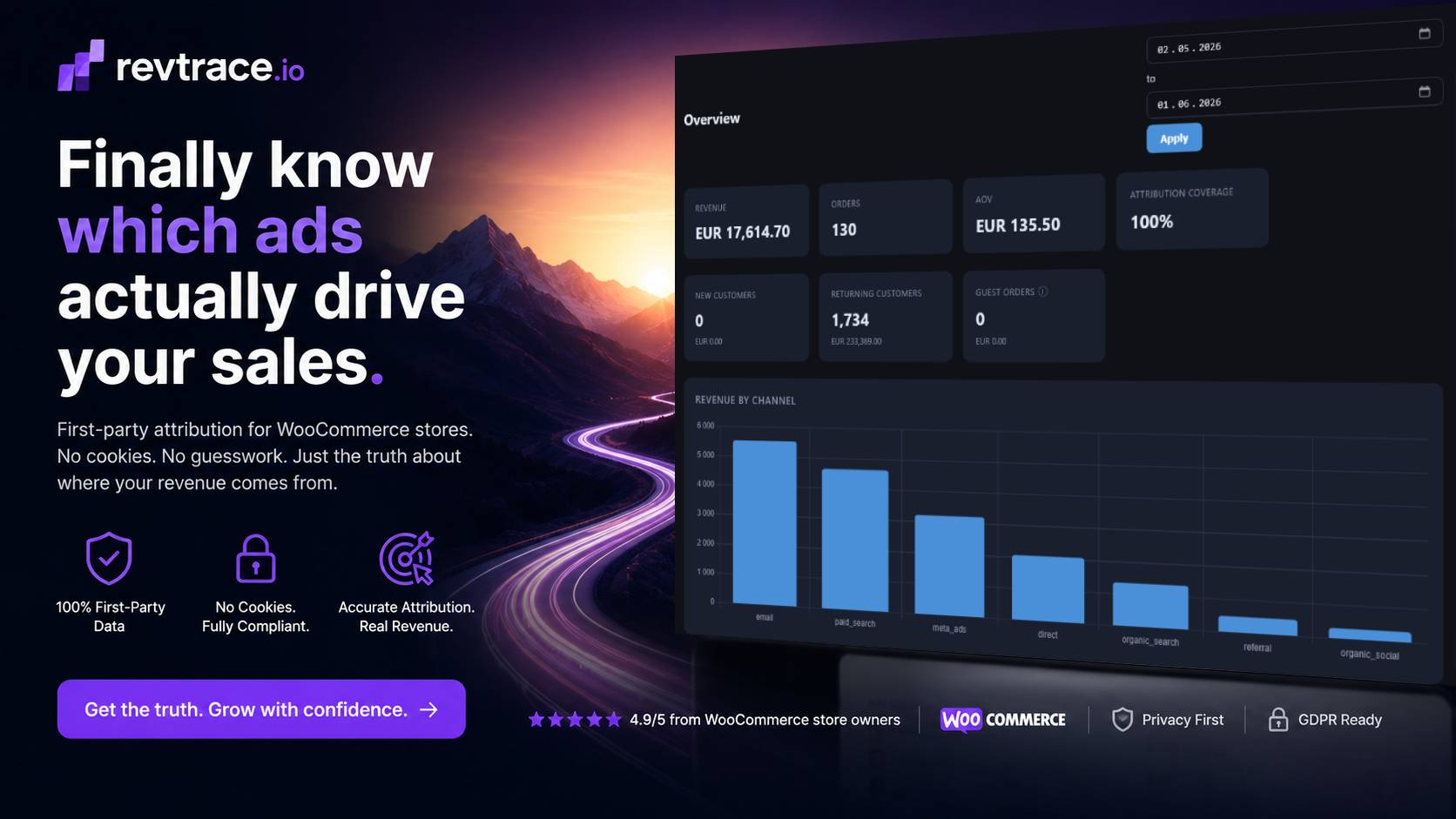
It shows you exactly how much revenue each marketing channel generated — verified against your actual WooCommerce orders — with zero reliance on third-party cookies or platform claims.
No complex setup. No developer required. No spreadsheet archaeology.
Just the answer to the question you’ve been trying to answer for years: which channel actually drove revenue last month?
Because the problem was never that WooCommerce stores can’t compete with Shopify stores. The problem was that WooCommerce store owners have been flying blind while their competitors could see clearly.
That’s a fixable problem. And once it’s fixed, everything changes.
The Question to Ask Yourself Right Now
Before you open another ad platform dashboard, before you approve next month’s marketing budget, before you have another “what’s working?” conversation with your team — ask yourself this:
Do I actually know which channels are driving revenue? Not according to the channels themselves. Not according to sessions in Google Analytics. According to my WooCommerce order data.
If the honest answer is no — you’re not alone. But you are leaving money on the table every single month.
The stores that figure this out first will scale faster, waste less, and make better decisions than the stores still guessing.
The question is which kind of store you want to run.